

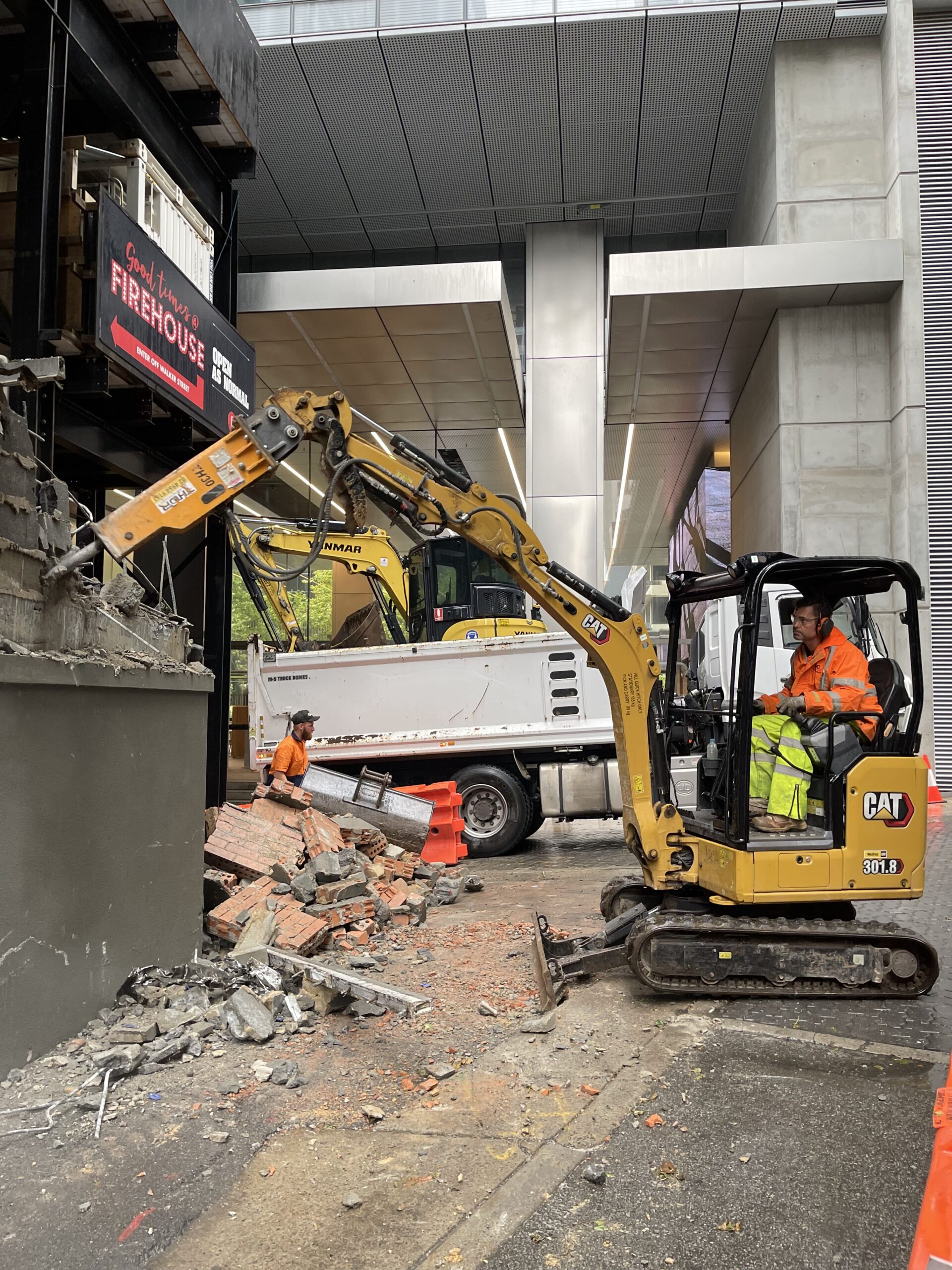
A backyard renovation in Leichhardt looked like a straightforward excavation job. The homeowner wanted to remove an old concrete area, prepare the ground for landscaping, and create space for a new outdoor entertaining area. The digging itself was not the difficult part. The real challenge was access. Like many Inner West terrace properties, the home had a narrow side passage between the house and the boundary fence. A standard excavator had enough power to complete the work, but it could not physically reach the backyard. The access point measured approximately 1.1 metres wide. That single measurement determined the entire equipment choice.
Instead of attempting to force larger machinery into a restricted space, East Coast Demo selected a compact excavator designed for residential areas with limited access. The machine travelled through the narrow passage, completed the excavation safely, and allowed the project to continue without removing structures or damaging surrounding areas. This is where modern mini excavation Sydney becomes more than just a smaller version of traditional excavation. It becomes the practical solution. Many Sydney properties are not built with large machinery access in mind. Older terrace homes, suburban blocks, and renovated properties often have narrow pathways, shared driveways, retaining walls, fences, and established gardens that limit what equipment can be used.
When homeowners search for professional mini excavation Sydney, they are often not looking for the smallest machine available. They are looking for a machine that can actually reach the area where the work needs to happen. You can learn more about our comprehensive mini excavation Sydney solutions for residential and restricted-access projects. At East Coast Demo, every excavation project begins with understanding the site. The right machine depends on access, ground conditions, excavation depth, and what needs to happen around the work area. A successful excavation is not only about removing soil quickly. It is about completing the work accurately while protecting the property.
To safely minimize property damage while preparing your site for machinery, follow our critical access preparation procedure immediately. First, measure your narrowest boundary entry point from fence to brick wall. Second, clear away all low-hanging tree branches, clotheslines, and outdoor clutter along the path. Third, keep your shared driveway clear so our specialized tilt-tray transport truck can unload the compact machine safely without blocking local traffic.
Quick Navigation Guide
- What Is Mini Excavation and Why Is It Used?
- Mini Excavator vs Standard Excavator: Which One Is Right?
- Why Sydney Suburbs Create Unique Excavation Challenges
- The Reality of Tight Access Excavation in Sydney
- Frequently Asked Questions
What Is Mini Excavation and Why Is It Used?
Mini excavation involves using compact excavators designed for smaller or restricted-access areas. These machines are commonly used for residential and commercial projects where larger equipment cannot operate efficiently. The main advantage of a compact machine is flexibility. A larger excavator may have more power, but power is not always the deciding factor on Sydney sites. In many cases, the biggest challenge is reaching the excavation area without causing unnecessary damage. A compact machine can manoeuvre through smaller spaces and provide operators with better control around existing structures.
Standard Operational Applications for Compact Fleet Machinery
The operational landscape of urban earthmoving requires tools that scale down in size without sacrificing structural breakout force. When we deploy our specialized fleet for mini excavation Sydney projects, we bring commercial-grade hydraulic power into spaces that were originally built long before modern mechanical equipment existed. This enables our team to clear sub-bases, bore deep piers, and slice through thick sandstone shelves while working within a footprint only slightly wider than a standard wheelbarrow path.
Our experienced teams use specialized mini excavators across a wide variety of site conditions to perform these typical applications:
- Backyard Excavation: Reshaping tight residential plots for grass, structural slabs, or modern extensions.
- Landscaping Preparation: Removing old soil layers, profiling tiers, and grading sub-bases for pavers.
- Drainage Trenching: Digging clean trenches for plumbing infrastructure, agricultural pipes, and electrical conduits.
- Retaining Wall Preparation: Cutting precise trenches and post-holes directly along boundary fencing lines.
- Pool Preparation: Shaping plunge pools and spa cavities in restricted suburban yards.
- Footing Excavation: Drilling concrete piers and structural column foundations beneath existing rooflines.
- Site Clearing: Scraping away thick weeds, brick rubble, and old construction debris fast.
- Concrete Removal Preparation: Breaking up old pathways and separating slabs for efficient disposal.
Navigating the Cost Realities of Compact Earthmoving
This is particularly important for properties where the excavation area is close to homes, boundary fences, garden areas, existing driveways, and neighbouring properties. One common misconception is that mini excavation Sydney is always chosen because it is cheaper. That is not necessarily true. The honest reality is that mini excavation is not always the cheapest option. It is often the only option that fits the site requirements. A large excavator may complete an open-block excavation faster, but it provides no advantage if it cannot access the backyard or work safely around the property.
Choosing the correct machine prevents unnecessary costs caused by damaged landscaping, removed fencing, difficult access preparation, or delays. For larger projects that require additional machinery, East Coast Demo also provides professional excavation Sydney services for a wide range of site requirements. The best equipment choice is based on the property, not simply the size of the machine.
Mini Excavator vs Standard Excavator: Which One Is Right?
Selecting excavation equipment requires careful consideration. The machine must match the available space, required depth, ground conditions, and type of work. To help you evaluate your project needs, we have broken down the operational differences below:
| Feature | Mini Excavation Sydney | Standard Excavation |
|---|---|---|
| Best For | Tight-access homes, terraces, backyards, landscaping | Large commercial sites and open blocks |
| Access Width | Can fit through narrow side access (approx. 750mm–1m depending on machine) | Requires wide site access |
| Property Protection | Minimal disturbance to gardens, fences and existing structures | Greater risk of damaging surrounding areas in confined spaces |
| Project Speed | Efficient for residential excavation and restricted spaces | Faster on large, open excavation sites |
| Cost | More economical for tight-access residential projects | Better value for large-scale earthmoving projects |
| Safety | Excellent control in confined spaces with reduced site disruption | Best suited to open areas with fewer access limitations |
The right machine is the one that can complete the job safely. For many Sydney homeowners, avoiding unnecessary disruption is just as important as completing the excavation itself. A compact excavator allows work to be completed in areas where traditional equipment simply cannot operate.
Why Sydney Suburbs Create Unique Excavation Challenges
Sydney excavation projects often involve challenges that are rarely seen on larger open sites. Suburbs throughout the Inner West and surrounding areas contain many older homes with limited space between buildings. Properties in locations such as Leichhardt, Ashfield, Marrickville, Newtown, and Balmain often have narrow side access, shared driveways, older underground services, boundary walls close to excavation areas, and heritage considerations. These conditions require planning before machinery arrives onsite. A contractor needs to understand not only what needs to be removed but also what needs to be protected.
Managing Subsurface Risks in Older Building Zones
For example, a terrace renovation may involve excavation directly beside an existing home. The operator needs to consider vibration, access limitations, and nearby structures. This is why specialized mini excavation Sydney machinery is often preferred for urban residential projects. The smaller footprint allows operators to work with greater precision and reduce unnecessary disturbance.
Before starting any major digging work near boundary parameters, it is absolutely vital to verify your contractor’s regulatory compliance. Every legitimate earthmoving company operating throughout New South Wales must carry comprehensive public liability insurance and hold valid operator credentials. You can verify a company’s licensed corporate details or industry structural standing through official government registry networks.
Hiring unlicenced backyard operators completely invalidates your residential building insurance if they accidentally rupture an undocumented water main, compromise a structural retaining wall, or damage a neighbouring boundary. At East Coast Demo, our professional operators focus on delivering fully insured, structurally sound tight access solutions, ensuring your land assets remain completely protected throughout the project.
Safeguarding Heritage Brickwork and Structural Foundations
Older properties throughout the metropolitan core rely on structural foundation profiles that can be highly sensitive to ground shifts. When our utility machinery conducts structural cuts or pool excavations, we monitor the structural resistance of the soil constantly to prevent any shifting of adjacent buildings. Choosing a provider that treats mini excavation Sydney as a discipline of precision asset management is the best way to safeguard historical terrace properties from vibration damage.
Our crew uses custom attachment packages like low-vibration dual-edge clay buckets to shape neat profiles without rattling fragile common walls. This conservative operational pacing is why our technical approaches are trusted by local families living in highly restricted urban streets. We prioritize the preservation of your primary real estate assets from the initial track touchdown to the final site sweep.
The Reality of Tight Access Excavation in Sydney
Sydney’s residential landscape creates some unique excavation challenges. Unlike large open construction sites where machinery can move freely, many suburban and Inner West properties require a more careful approach. A typical Sydney terrace renovation may involve working through a narrow side passage, shared driveway, or restricted backyard area where every centimetre matters. This is where mini excavation Sydney provides a practical advantage.
Mitigating Neighborhood Disruptions and Asset Friction
A compact machine can move into areas where standard equipment cannot reach, allowing excavation work to continue without major changes to the property. This can mean avoiding fence removal, protecting established gardens, and reducing disruption for homeowners and neighbours. One of the biggest challenges on older Sydney properties is working around existing structures. Many terrace homes were built decades ago, and the original layout was not designed for modern excavation equipment. Access points may be narrow, boundaries may sit close to buildings, and underground services may not always be where people expect them to be.
Before starting excavation, an experienced contractor considers the available access width, the condition of pathways and driveways, nearby structures, existing landscaping, underground services, and soil conditions. A professional approach is especially important for tight access excavation projects where mistakes can create unnecessary repairs or delays. The goal is not simply to bring machinery onsite, but to execute the task seamlessly while preserving the structural integrity of your home.
Precision Execution via Advanced Hydraulic Tracking Systems
Modern micro excavators utilize variable undercarriage systems that allow operators to reduce the machine’s absolute physical width on demand. This engineering configuration means we can track through an ultra-narrow side walkway and then open the track gauge back up to full width once inside your yard workspace. Utilizing this technology for mini excavation Sydney ensures the machine retains its full leverage, lifting capacity, and safety margins while actively pulling heavy loads out of the ground.
By combining expandable tracks with zero-tail-swing counterweights, our operators can rotate the upper cabin a full 360 degrees without the rear of the machine striking your boundary fence or home walls. This meticulous engineering control eliminates structural accidental impact risks completely. Our field strategies are developed from decades of navigating the tighter corridors of the city’s residential landscape.
Conclusion
When a residential construction project unfolds within a confined urban footprint, selecting the proper equipment profile can mean the difference between a seamless upgrade and an expensive structural disaster. Managing a tight-access site successfully relies entirely on executing a thorough pre-start assessment, mapping out all underground utility paths clearly, and deploying highly maneuverable compact machinery that prioritizes structural protection over raw mass.
Do not allow a tight side boundary gate or a narrow shared driveway to stall your property renovation plans and drive up structural alteration costs. If you are preparing to kick off a complex residential project or require precision site preparation right now, navigate over to our official contact us page to loop in the expert team at East Coast Demo & Excavation immediately, or request an obligation-free tight access quote online today.
Frequently Asked Questions
What is the minimum width required for a mini excavator to pass?
Our smallest tight-access mini excavators can retract their tracks hydraulically to clear entry points as narrow as 750mm to 1000mm. This engineering feature allows our compact machines to travel comfortably through a standard domestic doorway, a side pedestrian gate, or a narrow terrace boundary path. Once the machine successfully passes the narrow restriction and enters the open backyard workspace, the tracks expand outward to restore maximum operational stability.
How do you protect my existing driveways and paths from damage?
We protect delicate residential surfaces like stencilled concrete, clay pavers, or sandstone by placing thick rubber tracking mats or protective structural plywood sheets along the entire machine transit path. Compact mini excavators are also fitted with heavy-duty rubber tracks rather than aggressive steel cleats, which distributes the weight of the machine evenly. This design minimizes ground pressure and entirely prevents surface scratching, cracking, or deep track indentation.
Can a mini excavator break through hard rock and old concrete?
Yes, because compact excavators are highly versatile power platforms that can swap standard soil buckets for specialized attachments like hydraulic rock breakers and concrete demolition shears. If your backyard renovation involves clearing a thick, steel-reinforced old concrete slab or cutting through tough Sydney ironstone, we configure the machine with a heavy-duty hydraulic hammer. This setup breaks down hard material rapidly without producing the massive vibrations associated with full-size commercial equipment.
How do you manage underground services on older Sydney properties?
Before our tracking buckets ever touch your soil, we conduct a comprehensive utility clearance procedure using Dial Before You Dig (BYDA) plans combined with electronic subsurface scanning equipment. Older suburbs across the Inner West often feature undocumented, shallow, or deteriorating clay pipes that are highly vulnerable to crushing. Our operators combine advanced locator scans with careful hand-digging techniques around known utility lines to eliminate the risk of accidental supply line ruptures.
What are the main cost differences between mini and standard excavation?
While a large excavator can shift large volumes of open dirt at a lower rate per cubic metre, it becomes incredibly expensive if you have to dismantle boundary fences, hire cranes, or rebuild damaged brick structures to grant it access. Mini excavation carries slightly higher labor-to-volume ratios because the buckets hold less material, but it eliminates thousands of dollars in property structural restoration fees. This makes it the most cost-efficient choice for tight urban sites.
How deep can a compact mini excavator dig for structural footings?
A standard residential mini excavator can comfortably dig trenches and pier footings to depths between 2.2 and 3.0 metres, depending on the specific machine tonnage deployed. This depth capacity is more than adequate for standard domestic sewer installations, pool excavations, and structural retaining wall foundations. If your engineering plans require deeper drilling into bedrock, we attach specialized high-torque hydraulic augers to the machine boom to complete the task accurately.